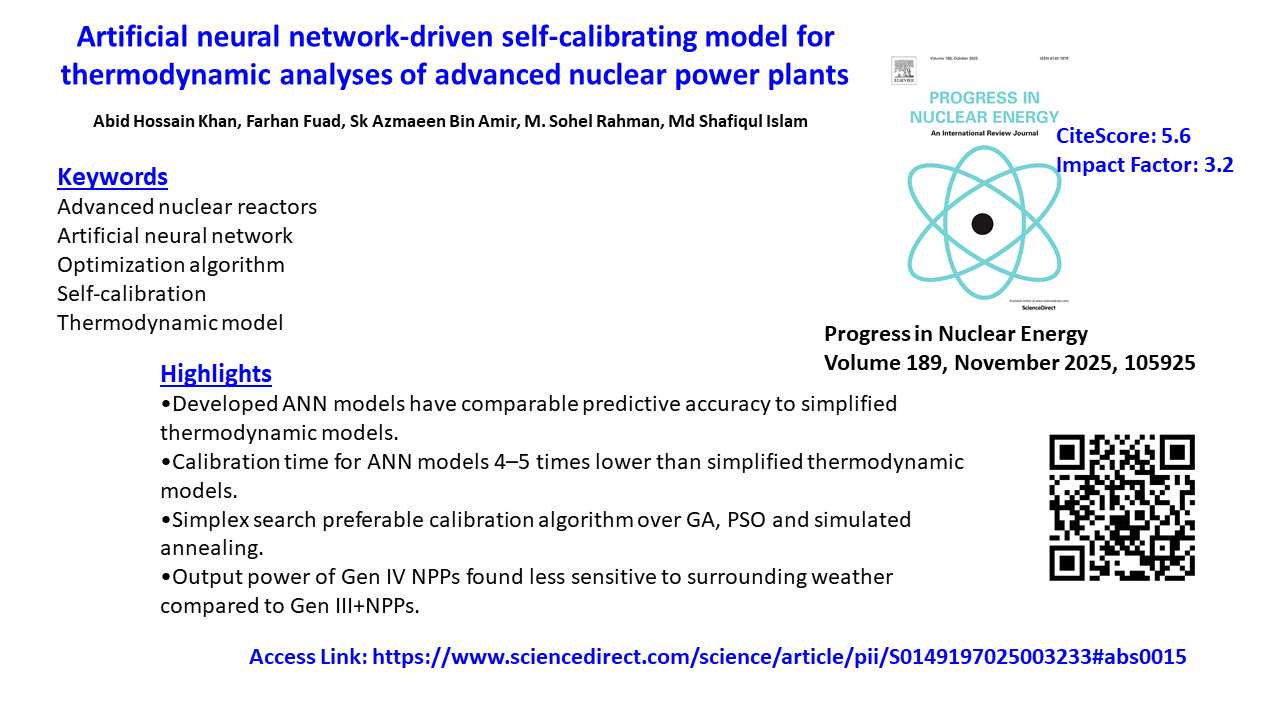
Recent publication of Prof. Dr. Shafiqul Islam: Artificial neural network-driven self-calibrating model for thermodynamic analyses of advanced nuclear power plants
Abstract
Research on optimization algorithms for calibrating a generalized thermodynamic model for advanced nuclear reactors is crucial. This study presents an effective method by employing artificial neural networks (ANNs) to calibrate a generalized thermodynamic model and evaluate the thermodynamic performance of advanced reactor-based nuclear power plants under varying weather conditions. Two self-calibrating ANN models were developed specifically for Generation III+ and Generation IV reactors, with each model trained using 10,000 data points. The study identifies that four-layer ANN models with hyperbolic tangent activation functions in the hidden layers yielded superior performance. Among the self-calibration methods evaluated, the Simplex search method outperformed simulated annealing, genetic algorithms, and particle swarm optimization. The ANN models achieved predictive accuracy comparable to simplified models but with significantly reduced self-calibration time, resulting in computational cost savings of 4–5 times. Additionally, the models revealed that Generation IV reactors experienced a 13.54–28.24 % lower efficiency decrease compared to Generation III+reactors when condenser pressure increased from 4 kPa to 7 kPa, indicating that Generation IV reactors are less sensitive to condenser pressure changes. The development of self-calibrating ANN models with optimized architectures and the comparative analysis of calibration algorithms contribute to more accurate, efficient, and cost-effective thermodynamic performance assessments. The findings provide valuable insights for reactor development and operational strategies regarding plant efficiency in varying weather conditions.
More details: https://www.sciencedirect.com/science/article/pii/S0149197025003233#abs0015