Ahead of polls, calls grow for gender-equal politics
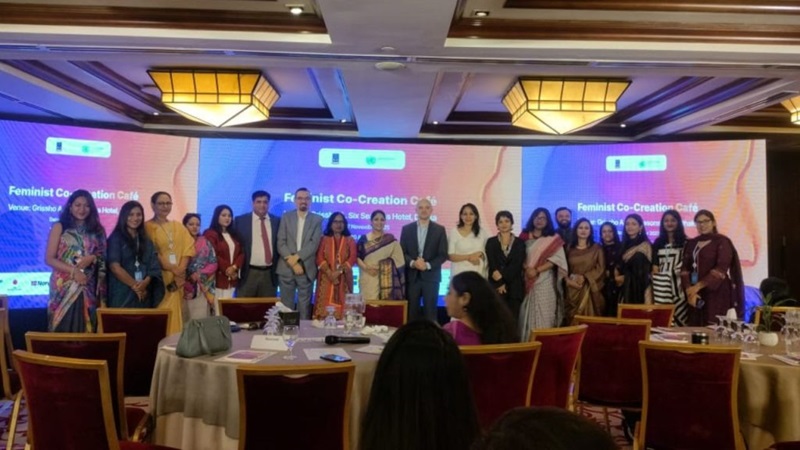
Women’s meaningful participation in politics must become a core priority ahead of Bangladesh’s next national election, experts said at an event titled Feminist Co-Creation Café.
The programme, jointly organised by UNDP Bangladesh and the Department of Women and Gender Studies at Dhaka University, was held at a city hotel on Thursday.
This discussion is part of the Women Manifesto Initiative, which aims to embed an intersectional gender-equity agenda into the commitments and platforms of major political parties. It seeks to ensure women’s substantive political participation and encourage the adoption of gender-sensitive policies.
According to the organisers, the programme has served as a collaborative platform for developing an evidence-based, intersectional Women’s Manifesto for Bangladesh.
Informed by a nationwide public opinion poll, the café convened feminist leaders, academics and political representatives to identify priorities, challenges and solutions for advancing gender-equitable political empowerment.
The organisers pointed out that the space was designed to bring diverse voices together, honour lived experiences and generate bold ideas.
They further stressed that women’s political empowerment in Bangladesh must be structural – embedded in institutions, laws and social norms – rather than symbolic.
With political parties refining their agendas ahead of the national election, speakers said gender justice must not remain a mere annex to their commitments, but a central pillar.
Professor Tania Haque of the Department of Women and Gender Studies at Dhaka University said, “We believe that together, we can create an intersectional vision that leaves no woman behind — regardless of geography, disability, class, age, sexual orientation or identity.
“Let us embrace the principles of respect, inclusivity, intersectionality and courage. Every voice matters here.”
UNDP Chief Technical Adviser Andrés Del Castillo Sánchez noted the gap between political parties’ public claims of inclusiveness and their actual nomination practices, adding that one party had nominated only 10 women while another had none.
“We cannot change the trend overnight. However, with small activities like the Feminist Co-Creation Café, we can do a lot. By involving our students, academia and the United Nations, we can help bring change,” he said.
Asif Kashem, senior programme manager at the Australian High Commission, said the initiative would help make political parties accountable once recommendations and survey findings are published.
He stressed the need to include men in the process, as well as women who reside in slums, belong to lower-income groups and serve as domestic workers.
UNDP Senior Programme Adviser Dragan Popovic said men must be educated to advocate for women’s rights. “If the burden is only on women’s shoulders, we are not moving forward,” he said.
Dr Sabiha Yeasmin Rosy, chairperson of the Women and Gender Studies Department at Dhaka University, said the project outlines a women’s manifesto for political empowerment that can serve as a crucial advocacy tool for promoting equal participation and leadership.
She highlighted long-standing barriers to women’s political leadership despite constitutional guarantees.
These include inadequate legal frameworks, structural inequalities, restricted mobility, discriminatory norms, safety concerns, financial limitations and underfunded political initiatives.
She said women’s representation still does not translate into meaningful decision-making power.
The manifesto notes that the lack of direct elections for reserved seats and insufficient support for women candidates further hinder progress.
It recommends policy reforms promoting mentorship, financial support, awareness campaigns and actions by political parties that place gender equality at the centre of their agendas.
The Feminist Co-Creation Café forms a key part of efforts to incorporate these priorities into political party platforms before the national election.
Bringing together feminists, activists, politicians, academics and policymakers, the café aims to identify gender-related political challenges and encourage solutions that influence voters, citizens and political actors to prioritise women’s interests and empowerment.
This initiative seeks to support policy drafting, expand representation, strengthen capacity, promote advocacy and leadership, and turn recommendations into action.