Inauguration of CGDS-UN Women Policy Dialogue Series on Gender Equality and Development and first dialogue held at Dhaka University
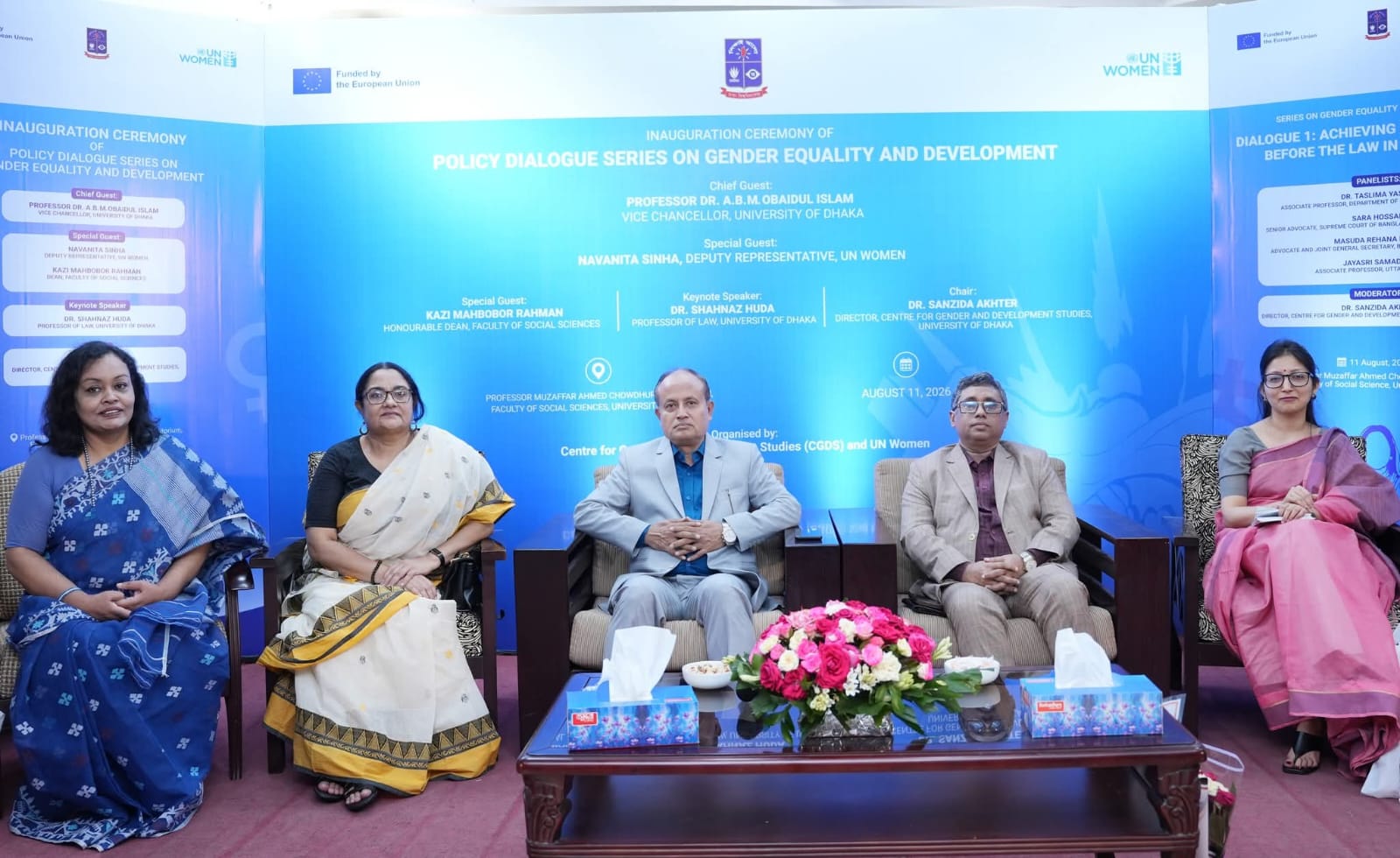
On Tuesday morning, August 11, 2026, at 10:00 AM, the inaugural ceremony and the first dialogue (Dialogue 1) of the "CGDS-UN Women Policy Dialogue Series on Gender Equality and Development" were held at the Professor Muzaffar Ahmed Chowdhury Auditorium, Faculty of Social Sciences, University of Dhaka. The event was jointly organized by the Center for Gender and Development Studies (CGDS), University of Dhaka, and UN Women, with support and funding from the European Union.
The primary objective of this dialogue series is to thoroughly analyze Bangladesh's existing legal, social, and economic systems through a dedicated gender lens. Concurrently, it aims to present specific and realistic policy recommendations for necessary legal reforms, structural changes, and gender-responsive policymaking at the decision-making level.
According to the event schedule, following guest registration from 9:30 AM to 10:00 AM, the main inauguration ceremony commenced at 10:00 AM. The formal proceedings began with a welcome speech and opening remarks by Professor Dr. Sanzida Akhter, Director of CGDS and Professor in the Department of Women and Gender Studies. Highlighting the core objective and significance of the initiative, Professor Dr. Sanzida Akhter stated, "This has primarily been established as an academic forum, through which we are working to build a platform for various research dialogues, knowledge creation, and dissemination." She expressed hope that this series would spark fresh insights among faculty and students regarding contemporary gender issues and help identify existing policy and gaps on the path to establishing equality.
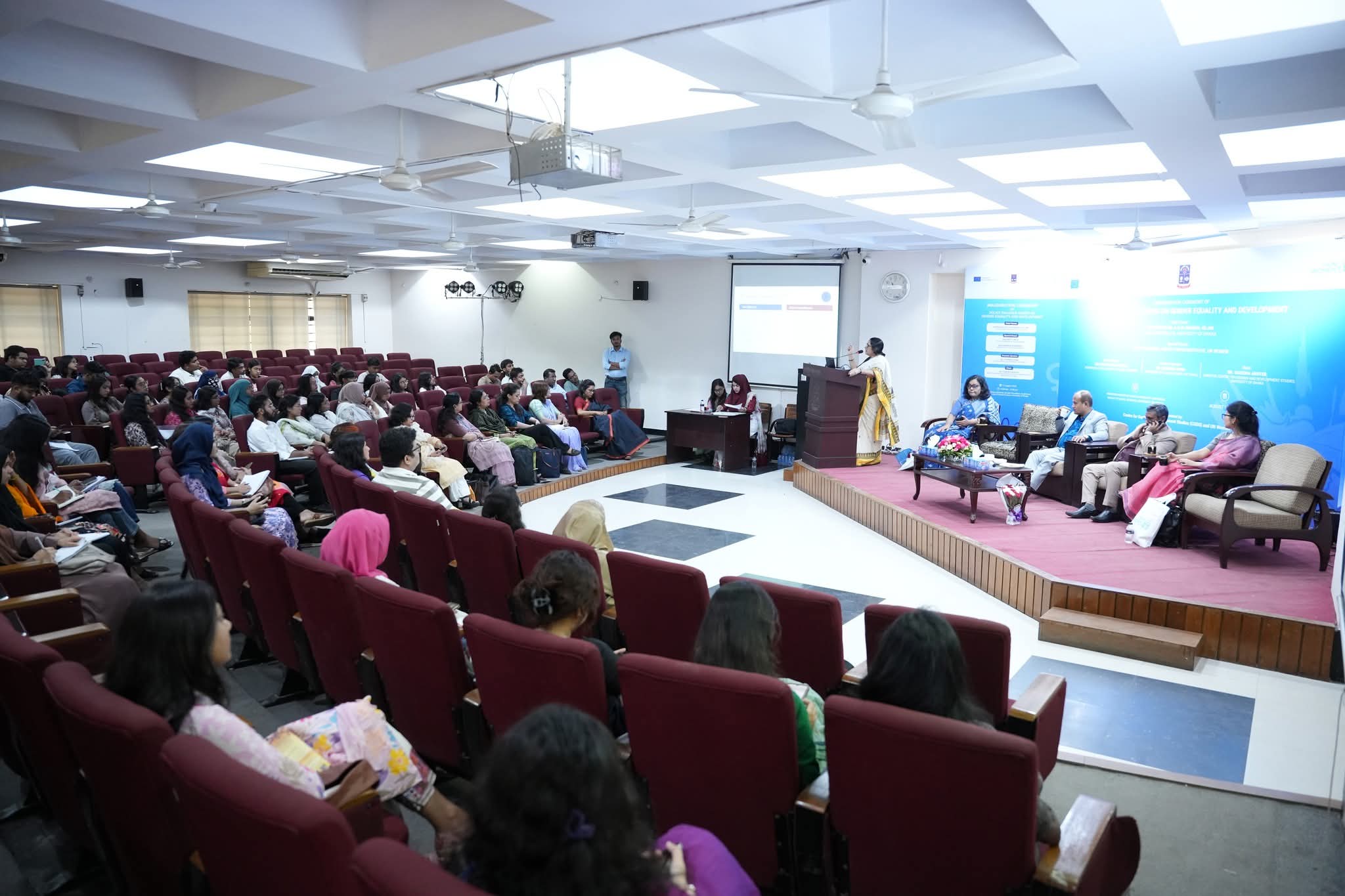
During the inaugural session, Professor Dr. Shahnaz Huda, Department of Law, University of Dhaka, delivered the keynote presentation. In her address, she highlighted the gap between the constitutional commitment to equality and its actual legal enforcement.
Professor Dr. A. B. M. Obaidul Islam, Vice-Chancellor of the University of Dhaka, graced the occasion as the chief guest and announced the inauguration of the dialogue series. He underscored gender equality as a prerequisite for achieving Sustainable Development Goals (SDGs) 5 and 16. He remarked, "No country or society can achieve these global goals while keeping more than half of its population legally or socially marginalized."
On the other hand, Professor Dr. Kazi Mahbubur Rahman, Dean of the Faculty of Social Sciences, called for viewing this struggle through a broader lens. He stated, "Are we going to get caught up in these gender semantics, or will we treat everyone from our primary focus—as human beings? We do not want liberation merely as men or women; we want liberation as human beings." His remarks emphasized that true liberation lies in valuing people as human beings rather than getting lost in wordplay.
_1786943686.jpeg)
During her address, Navanita Sinha, Deputy Representative of UN Women, presented an overview of the current legal landscape in Bangladesh. She noted, "Women in this country enjoy only 64% of legal rights that men enjoy." She cited the lack of legal recognition for marital rape and restrictions on women entering certain occupations under labor laws as discriminatory practices.
The inaugural session concluded with a vote of thanks delivered by Aditi Sabur, Associate Professor in the Department of Women and Gender Studies, University of Dhaka.
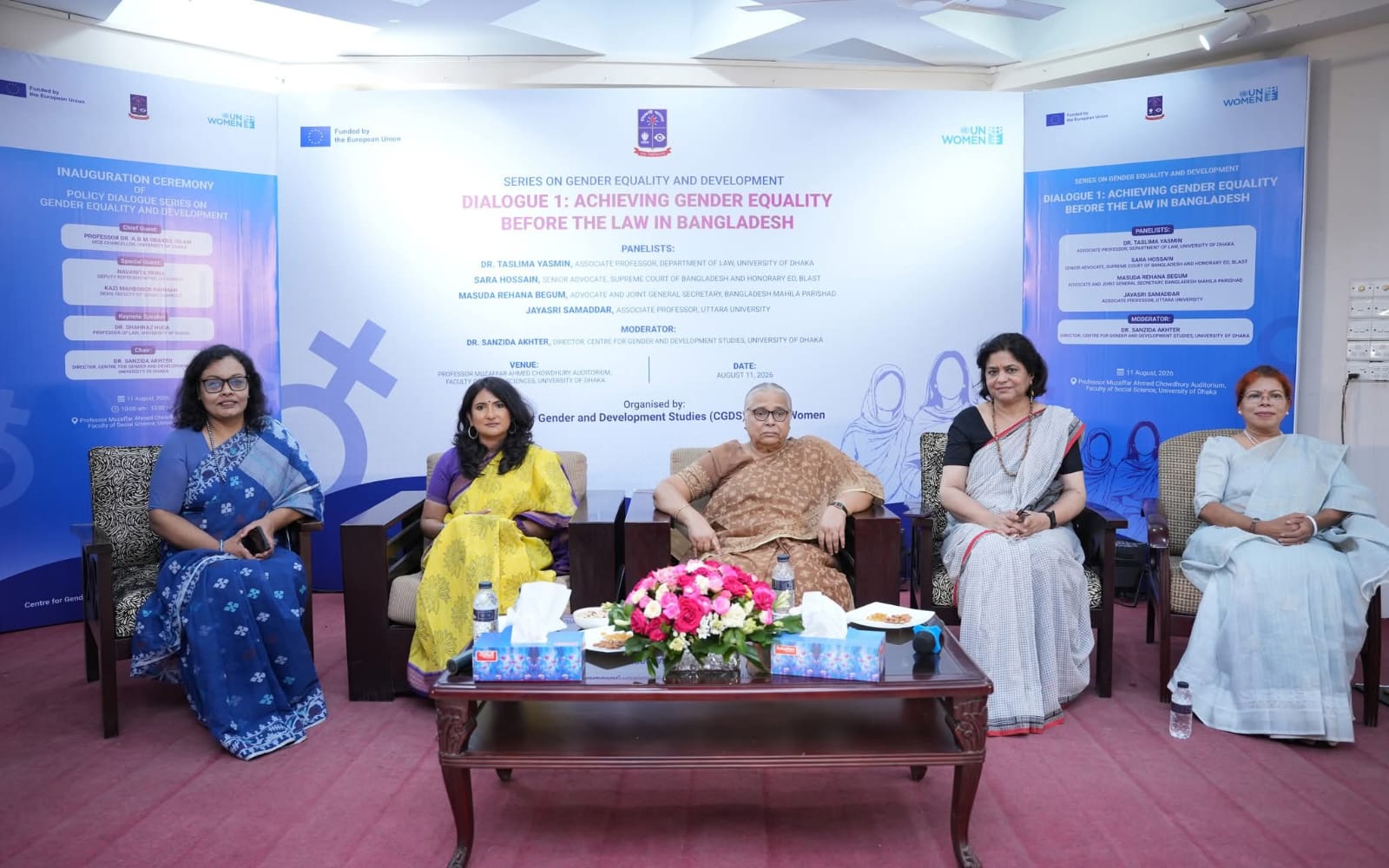
The core segment of the event featured a panel discussion titled "DIALOGUE 1: Achieving Gender Equality Before the Law in Bangladesh." Following the opening ceremony, this first dialogue was moderated by Professor Dr. Sanzida Akhter. The panel comprised Dr. Taslima Yasmin, Associate Professor, Department of Law, University of Dhaka; Sara Hossain, Senior Advocate at the Supreme Court and Honorary Executive Director of BLAST; Masuda Rehana Begum, Joint General Secretary of Bangladesh Mahila Parishad; and Joyasree Samaddar, Retired District and Sessions Judge.
The event featured in-depth discussions regarding the gap between the promises of equality enshrined in the Constitution of Bangladesh and their practical implementation. Both the keynote presentation and panel discussions highlighted that personal laws continue to discriminate against women. Associate Professor Dr. Taslima Yasmin from the Department of Law, University of Dhaka, pointed out several severely discriminatory aspects of the revised 2026 law, stating, "If a child bride aged 13 or above becomes a victim of rape by her husband, we are still not classifying that marital rape as rape. A 13-year-old child cannot file charges of rape against her husband." Panelists also noted that the complicated definition of "dowry" under the Dowry Prohibition Act, along with equal penalty provisions for both the giver and the receiver, makes it difficult for victims to secure justice.
Bureaucratic hurdles and institutional reluctance were identified as major obstacles to lawmaking and implementation. Citing the Domestic Violence Act as an example, Barrister Sara Hossain stated, "Many worked together during the drafting stage of the law. However, once it passed through the Ministry of Law, a significant alteration was made: if someone gets divorced, she can no longer seek protection under this law." She further added that even after legislation is enacted, the lack of proper training for police, lawyers, and judges, alongside prolonged judicial delays, severely restricts access to justice. Advocate Masuda Rehana Begum highlighted the pivotal role of women’s rights organizations in driving legal reforms toward gender equality in Bangladesh. She called upon the younger generation to carry forward the legacy of organizations like Bangladesh Mahila Parishad, which has been fighting for women's rights for decades. Concurrently, Jayasree Samaddar acknowledged that while current laws are largely adequate, critical challenges persist in their implementation and in securing women's access to justice.
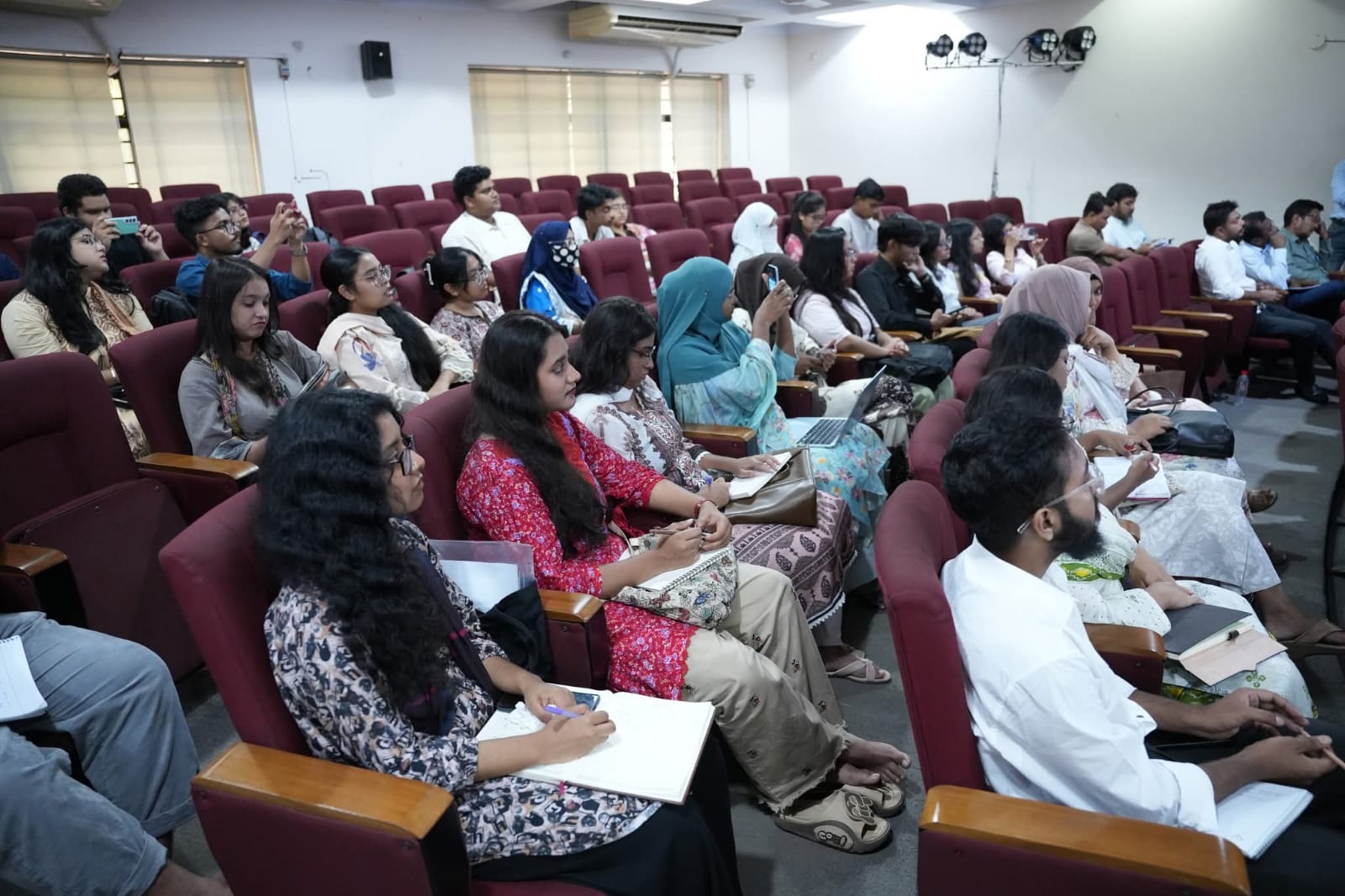
The discussions placed significant emphasis on the structural discrimination against women embedded in personal laws, labor laws, and penal codes—contrasting sharply with the equality guaranteed by Bangladesh's Constitution. Key concerns included the non-recognition of marital rape, procedural complexities of the dowry act, and provisions under the guise of protection that restrict women's workplace participation.
Overall, the discussion made it evident that enacting legislation alone will not achieve gender equality; rather, it requires removing discriminatory clauses, ending the culture of impunity, and fundamentally transforming societal mindsets. Toward the end of the event, students were invited to participate in a policy paper competition to help shape national policy through youth perspectives.
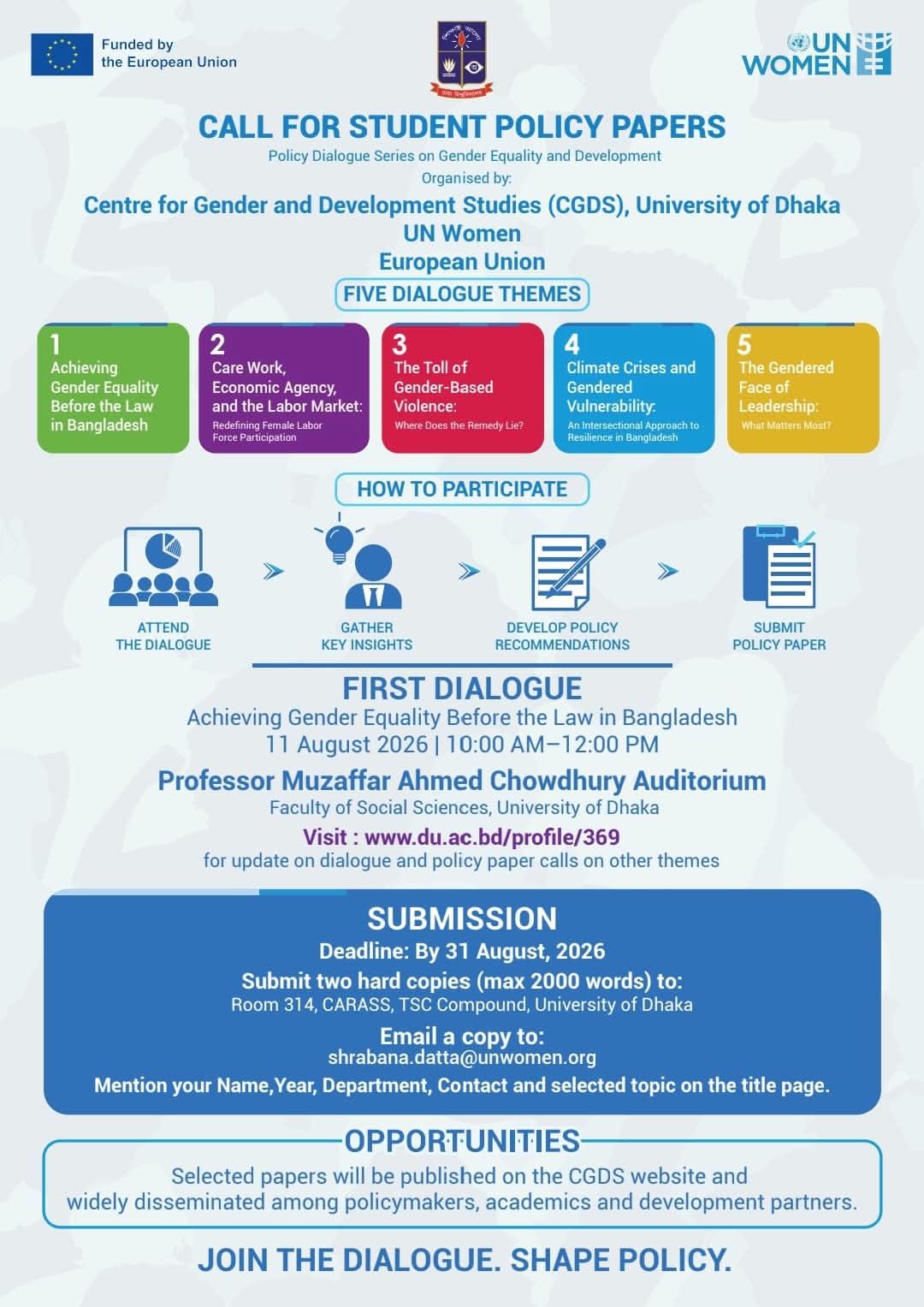
Call for Student Policy Papers
During the final segment, the "Call for Student Policy Papers" competition was officially announced to encourage innovative ideas and research from the youth to inform national policy decisions. The call for Student policy paper on the first theme “achieving gender equality before the law” is open now. This call is only for students of any department/faculty of Dhaka University. Single or co-authored (maximum two authors) policy paper is accepted.
Guidelines for Policy Papers:
● Five Main Dialogue Themes:
1. Achieving Gender Equality Before the Law in Bangladesh (This call is open now)
2. Care Work, Economic Agency, and the Labor Market: Redefining Female Labor Force Participation
3. The Toll of Gender-Based Violence: Where Does the Remedy Lie?
4. Climate Crises and Gendered Vulnerability: An Intersectional Approach to Resilience in Bangladesh
5. The Gendered Face of Leadership: What Matters Most?
● Submission Guidelines: Interested students must submit a policy paper of up to 2,000 words on theme 1 by August 31, 2026.
● Submission Venue & Process: Two hard copies must be submitted to Room 314, CARASS Building (TSC Compound, University of Dhaka), and a soft copy emailed to shrabana.datta@unwomen.org.
● Opportunities: Selected policy papers will be published on the CGDS website and distributed among policymakers, academics, and development partners.