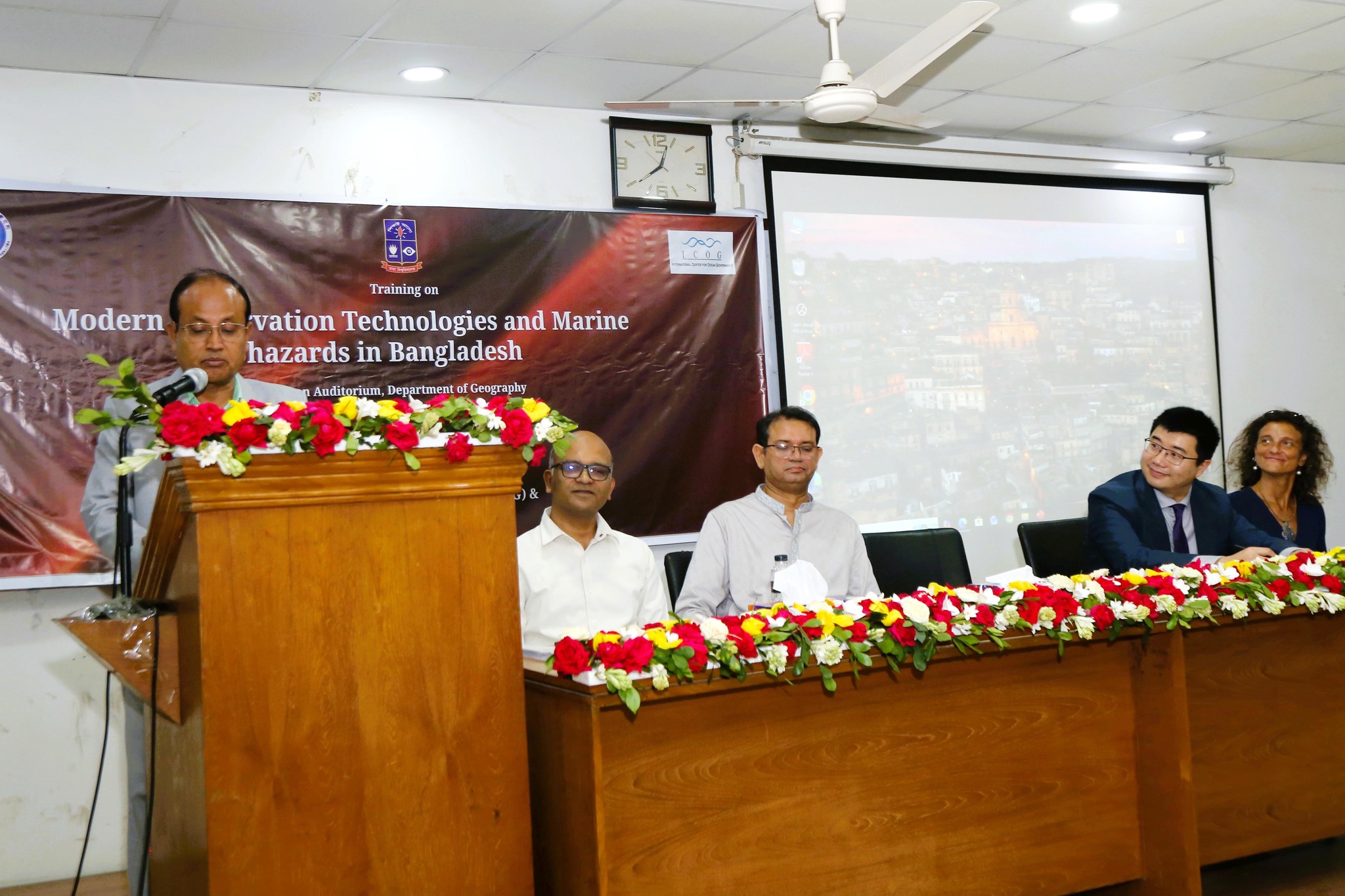
Training on Modern Ocean Observation Technologies & Seminar on the Inception of the Heat Project: Progress and Future Plan
Inaugural session
On the upcoming occasion of World Ocean Day 2026, under the theme “Strong Marine Protected Areas for Our Blue Planet,” a seminar titled “Training on GNSS Buoy and Surface Wave Measurement” and “HEAT Project Inception: Progress and Future Plans” was jointly organized by the International Center for Ocean Governance (ICOG), Department of Oceanography, University of Dhaka, and the First Institute of Oceanography, China.
The seminar was held under the HEAT (Higher Education Acceleration and Transformation) sub-project entitled “Modeling the Climate Change Impact on Coastal Pollution Dynamics and Developing an Interactive Environmental and Water Quality Database for the Coastal Area of Bangladesh for Sustainable Blue Economy.” The event took place on 2 June 2026 (Tuesday) from 12:00 PM to 5:00 PM at the R. I. Khan Auditorium, Department of Geography and Environment (Revised Venue), University of Dhaka.
Under the HEAT ATF Sub-Project 13025, the seminar was inaugurated by the Honorable Vice-Chancellor of the University of Dhaka, Professor Dr. A.B.M. Obaidul Islam, as the Chief Guest.
Among the distinguished speakers were Professor Dr. Md. Humayun Kabir, Dean of the Faculty of Earth and Environmental Sciences; Dr. Tonia Astrid Capuano, International Expert of the HEAT Project; and Dr. Shumin Jiang, Scientist at the First Institute of Oceanography (FIO), China. The welcome address was delivered by Professor Dr. K. M. Azam Chowdhury, Director of the International Center for Ocean Governance (ICOG).
The seminar was attended by faculty members, researchers, and students from various universities across the country, as well as representatives from several key national institutions, including the Ministry of Fisheries and Livestock, the Bangladesh Navy, Bangladesh Coast Guard, Mongla, Payra , Chittagong Port Authority and the Bangladesh Space Research and Remote Sensing Organization (SPARRSO). Scientists from the First Institute of Oceanography (FIO), China, also participated in the event.
The closing ceremony of the seminar was scheduled to be graced by Professor Dr. Abdus Salam, Pro-Vice Chancellor (Academic) of the University of Dhaka, as the Chief Guest. In this part, certificates were awarded by the chief guest for the participants.
As a symbol of mutual cooperation, commemorative crests were exchanged between ICOG-DU and FIO during the program.
In his keynote address, Vice-Chancellor Professor Dr. A.B.M. Obaidul Islam emphasized the importance of international collaboration in advancing ocean science, coastal environmental monitoring, and climate resilience. He stated that the ongoing scientific partnership between Bangladesh and China has opened new avenues for marine resource management, coastal risk reduction, and sustainable development.
The Vice-Chancellor further noted that Bangladesh’s Bay of Bengal-centered economy, the livelihoods of coastal communities, biodiversity conservation, and climate resilience are closely dependent on the sustainable management of marine resources. In this context, the joint research initiatives with the First Institute of Oceanography are making significant contributions to strengthening the country’s marine observation capabilities.
He highlighted the successful deployment of a GNSS buoy in the Andaman Sea and the ongoing initiative to install another GNSS buoy in the Meghna Estuary, which will further enhance Bangladesh’s marine monitoring system. These technologies are expected to play a crucial role in coastal management, maritime safety, disaster preparedness, climate adaptation, and sustainable Blue Economy planning.
Commending the progress of the internationally competitive and approved HEAT sub-project, the Vice-Chancellor remarked that this achievement represents international recognition of the capabilities of Bangladeshi researchers. He expressed optimism that the project’s research outcomes would make valuable contributions to policy formulation related to sustainable development and environmental management.
He also encouraged young researchers and students to engage actively in internationally recognized research activities, emphasizing that the future leadership of marine and climate-related research rests with the younger generation. Through knowledge, innovation, and international cooperation, they can play a vital role in building a healthy marine environment and a climate-resilient world.
During the technical session of the seminar, scientists from FIO presented papers on advanced ocean observation technologies, marine geohazards, and coastal environmental management. Presentations were also made on the progress of the HEAT project, its modeling framework, and the GNSS Buoy Deployment Project, including the screening of a documentary. An interactive question-and-answer session was held with the participants.
The program integrates state-of-the-art field-based technologies with advanced numerical modeling approaches. Using the Delft3D modeling system, researchers will investigate climate change-induced pollution dynamics, the dispersion of toxic substances, and the identification of pollution accumulation zones in coastal regions. In parallel, plans are underway to develop an interactive environmental database that will support marine biodiversity conservation.
This initiative will provide researchers with opportunities to enhance their expertise in real-time buoy data analysis, oceanographic modeling, coastal risk forecasting, and environmental monitoring. Furthermore, it will establish an effective platform for assessing the impacts of microplastics, heavy metals, and oil pollution, thereby facilitating science-based decision-making for environmental management and pollution mitigation.
Technical and Seminar Session
The technical session brought together leading scientists and researchers from the First Institute of Oceanography (FIO), China, and the International Center for Ocean Governance (ICOG), University of Dhaka, to share recent advancements in ocean observation, marine geohazards, and climate-related research.
The session commenced with a presentation by Dr. Shumin Jiang, who discussed innovations in oceanographic modelling and public service products. He also provided an overview of the newly developed GNSS buoy system and highlighted its applications in real-time marine environmental monitoring, ocean forecasting, and coastal management.
Mr. Yanliang Guo presented the latest developments in GNSS buoy technology and mooring structures. His presentation focused on technical improvements in buoy deployment systems, operational stability, and data acquisition capabilities, emphasizing their importance for long-term marine observation and monitoring.
In another keynote presentation, Dr. Yonggui Yu addressed the issue of inefficient burial of organic carbon in deltaic environments. He explained the mechanisms controlling carbon sequestration in river deltas and discussed the implications for climate change mitigation, blue carbon management, and coastal ecosystem sustainability.
Mr. Xin Shan delivered a presentation on marine geohazards in Bangladesh, highlighting various coastal and offshore geological risks, including seabed instability, erosion, sediment dynamics, and their potential impacts on coastal infrastructure and marine resources. He emphasized the importance of advanced monitoring and assessment techniques for effective risk management and sustainable coastal development.
The progress and future directions of the HEAT ATF Sub-Project 13025, titled “Modeling the Climate Change Impact on Coastal Pollution Dynamics and Developing an Interactive Environmental and Water Quality Database for the Coastal Area of Bangladesh for Sustainable Blue Economy,” were presented by Professor Dr. K. M. Azam Chowdhury and Dr. Tonia Astrid Capuano. They outlined the project's objectives, methodological framework, ongoing activities, expected outcomes, and its significance in strengthening Bangladesh’s capacity for coastal pollution assessment, environmental monitoring, and sustainable Blue Economy planning.
The technical presentations were followed by an interactive question-and-answer session, during which participants engaged in fruitful discussions with the speakers on ocean observation technologies, numerical modelling, marine environmental challenges, and future research collaborations between Bangladesh and China.
The session concluded with a vote of thanks delivered by Professor Dr. K. M. Azam Chowdhury, Director of ICOG. He expressed his sincere gratitude to the distinguished guests, speakers, researchers, participants, and organizing team for their valuable contributions and active participation, which ensured the success of the seminar.