Awareness Programs on Frog Conservation Held at Two Schools in Rangamati and Khagrachhari
Awareness Programs on Frog Conservation Held at Two Schools in Rangamati and Khagrachhari
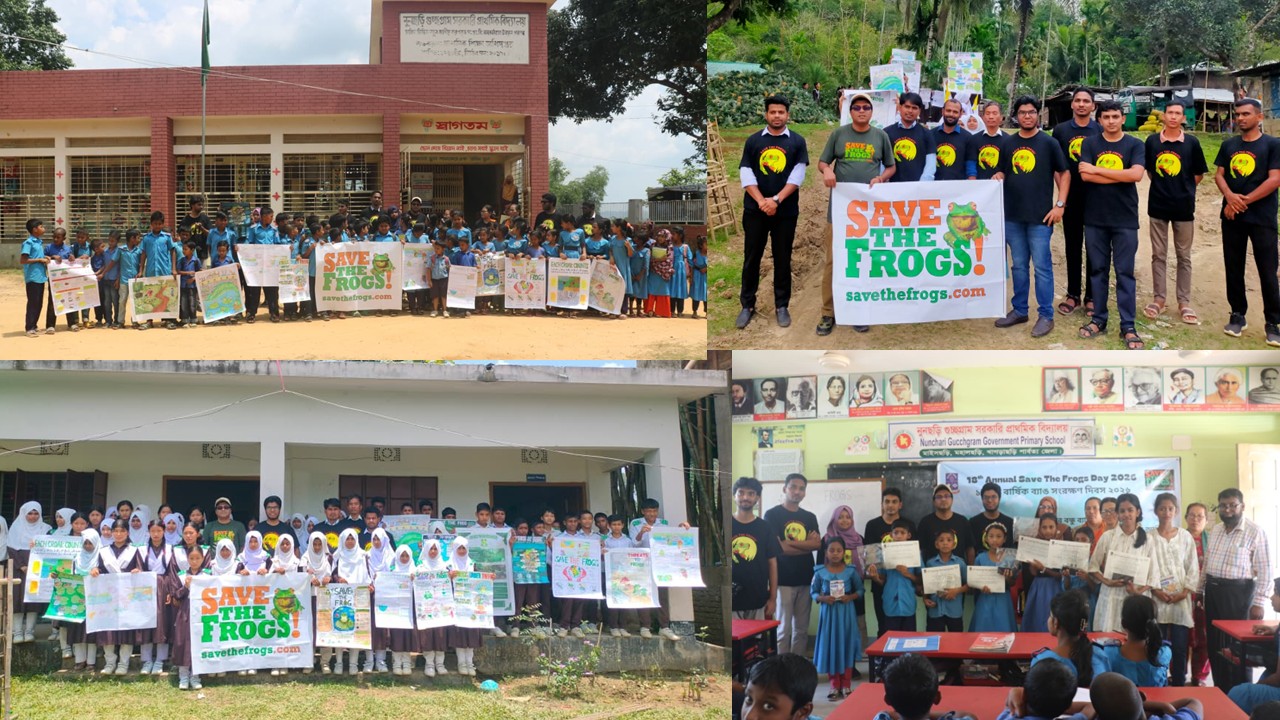
To raise global awareness about frog conservation, SAVE THE FROGS! observes “Save The Frogs Day” every year on April 28. As part of the 18th Annual Save The Frogs Day 2026, Department of Zoology of University of Dhaka organized a two-day awareness campaign on frog conservation at two educational institutions in Rangamati and Khagrachhari with the support of SAVE THE FROGS!. The program was conducted under the supervision of the department’s respected faculty members, Dr. Md. Mokhlesur Rahman and Md. Fazle Rabbe, along with a group of students from the wildlife branch of the department.
The events were held on May 6, 2026, at Bogachhari Al-Amin High School in Rangamati and on May 7, 2026, at Nunchhari Gucchagram Government Primary School in Khagrachhari. The main objective of the initiative was to increase awareness among primary and secondary school students about frogs, their ecological importance, their role in biodiversity conservation, the threats they currently face, and the necessity of protecting them. Various educational and participatory activities were arranged throughout the two-day program. The events began with an inauguration ceremony followed by an awareness rally. Students’ prior knowledge about frogs was assessed before expert discussions and presentations were conducted. Quiz competitions and frog-themed drawing competitions were also organized to encourage active participation among students. At the end of the program, a post-discussion evaluation session was conducted to assess the students’ learning progress and understanding. Later, prizes and certificates were distributed among the participants and winners. During the closing session, both teachers and students expressed their enthusiasm and pledged to help protect frogs and other wildlife.
It is noteworthy that this year, Mehedi Hasan Tareq, a Master’s student (Wildlife) from the Department of Zoology, received a fellowship from SAVE THE FROGS! for his research and awareness activities related to frogs.
The organizers expressed hope that such initiatives would help foster positive attitudes toward environmental and wildlife conservation among local students and contribute to developing a more aware and responsible future generation.
As part of the program, the faculty members and students also conducted two nights of field surveys in the surrounding areas to observe the current status of frogs. During the surveys, several frog species were recorded, while threats such as plastic and polythene pollution in frog habitats were also observed. Local residents were advised and made aware of these environmental threats.
The organizers further emphasized that awareness programs like these can gradually change public perceptions toward wildlife in remote areas of Bangladesh and play an important role in ensuring long-term human–wildlife coexistence in the future.